Skip to content Skip to footer

“One thing that makes a martial art powerful, is that it teaches to recognize the how and when to utilize the strengths and weaknesses of the opponent to win the fight. We must do the same in soccer and do it as ONE.”

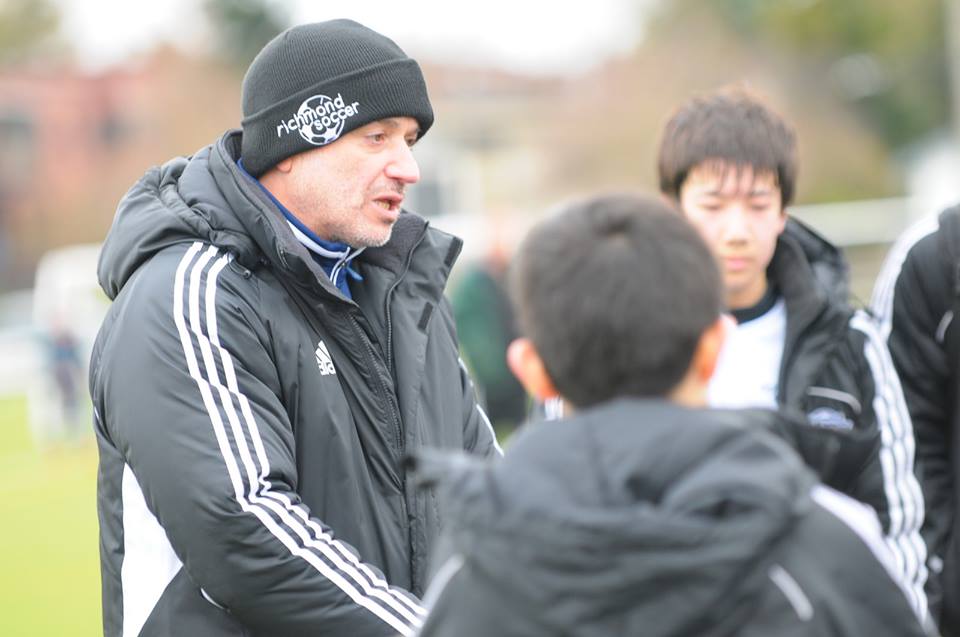
Global Evolution Program – Coach Roberto Sciascia

Rather than compartmentalizing soccer into the technical, tactical, mental and physical, I prefer to combine these aspects of the game of soccer into a Global Evolution Process. It is a journey that will take us in a different direction every time. No matter what the level or the age of the group, it becomes a shared journey in which there is time to go back and solidify and hone principles learned in earlier years within the team context. It is more important to find a Tactical System appropriate for the quality level of the players than to simply work at developing separate skills and tactical knowledge. I want those Soccer Qualities to become Second Nature.

“If you try to learn soccer with your intellect or as separate skills, it is more difficult to absorb the teachings 1pat a deep level. Your mind looks at teachings, and in the midst of battle says, I don’t want that. Instead, continue to train with a team in a holistic way until something changes. What changes is deeper than intellectual knowledge, deeper than your mind or heart.”

Why Second Nature?

Generally, around U12 players are beginning to identify with the idea of belonging to a team. It is important to allow them to discover, at least superficially, different Tactical Systems and their respective implications. I am slowly introducing them to the concept of Team Consciousness. This is a Global process that requires a lot of training and repetitions of situations that will make all the players react in the same manner, no matter who the opponents are. Team Consciousness is a Global Concept. It does not require that the coach separate the different aspects of soccer to manifest them.

Coaching should not be about treating training as an elimination process, where players practice something a few times and it is done, and on to the next subject. Alternatively, all the principles and fundamentals learned at a certain age group are carried on, and carefully built upon in the next level. Mastery is a gradual process. It is a never-ending building and repeating process, which will allow them to acquire an unconscious knowledge where the body and the knowledge is one.

Coaching Responsibility

My responsibility as a coach is to instil in players a conscious intention to respect the social rules and give them enough force and consistency for them to dominate their unconscious intentions and acts. How many times, in the heat of a moment, have we reacted in a way that we regretted? Most reactions and actions during a game are not conscious.

A player does not ask himself, “What do I do now?” or “How can I do that?” He needs to simply “Do.” The player acts as a consequence of the habits that he or she has acquired during all the years of training—bad or good.

How to Get Players to Play at a Level Where Second Nature Kicks In?

I first establish a clear Game Model or Tactical System adapted to the level of my players. For me, a Tactical System is never a rigid system. It is all about flexibility, adaptability, awareness and fluidity. Ideally I will have two different Models that I will work all season long. Then, I define the fundamental principles of this Tactical System relative to the four most important moments of the game:
These principles give structure and strong organization to my team. They are mainly references to actions and reactions, behaviors I want them to adopt during the game and will force them to play as a team. By insisting on and training in tactical organization within these four moments, players will improve the collective discipline and organization of the team. Technical, Physical, Tactical and Psychological qualities will improve as a natural consequence of this collective organization.
Training Approach & Intensity

Naturally, this improvement will only be possible if the training is done with the same intensity as the competitive level of a game. To train well, I propose exercises that replicate what the team will do in the game and renew them constantly every time the players solve them too easily.

Repeating this kind of training leads the players to a real unconscious assimilation of my Team organization. Intensity is the necessary level of concentration to solve complex exercises. The more complexity is introduced into the exercise, the more concentration is required, and the more intense the exercise becomes. Intensity must be trained gradually and appropriately for the age group. Exceptions are made during “Recovery” training, immediately after or before a game.

Conclusion

Naturally, this is only a summary of what this Global Evolution Process encompasses. It is a very long and arduous process and it requires a lot of knowledge, study, preparation, work, attention and dedication, and communication between the coaches. It would be a lot easier for everybody to get comfortable and continue to separate everything and train the same way as most clubs. Does it mean that to attract good players we just have to be different? I don’t think so.

But, we can certainly do it by presenting a quality program built around the only true value of soccer presently: the improvement of the team as a whole. Only with team improvement is it possible for players to improve. Done this way, it allows soccer teams, and subsequently whole clubs, to gain and express a clear identity in the global soccer community.

01 06